
One Placement Plan Can’t Prepare Every Student. Do You Know Why?
Students often follow the same placement preparation plan—same coding sheets, same courses, and same interview questions. But their skill gaps are different. This blog explores why generic preparation fails, how students can identify what they actually need to improve, and why a personalised roadmap leads to stronger placement readiness.
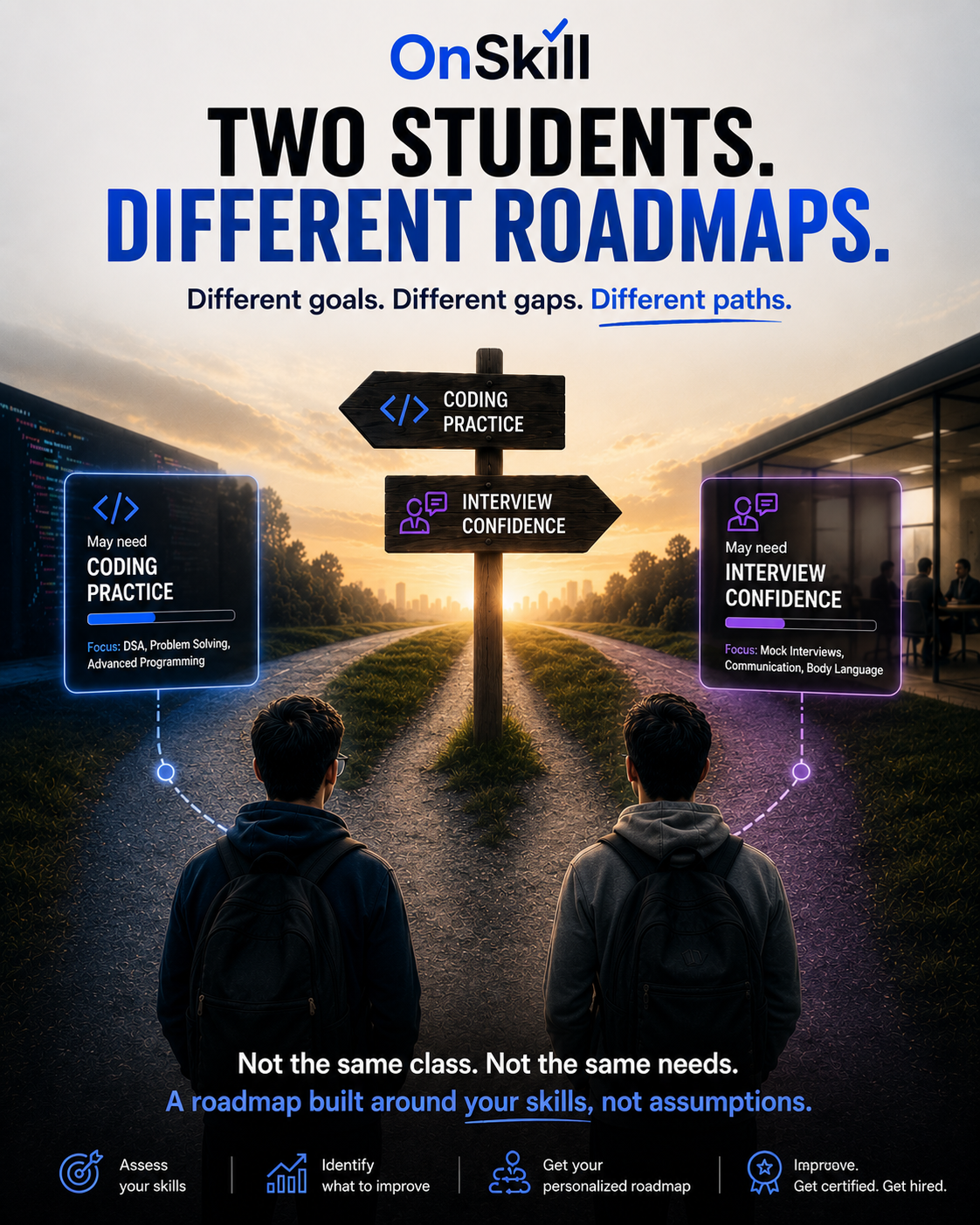
Why Every Student Needs a Personalised Roadmap for Placement Success
Most students preparing for placements are doing a lot.
They attend classes, complete courses, solve coding questions, update their resumes, collect certificates, and watch interview videos.
Yet, as placement season gets closer, one question remains:
“Am I actually ready?”
The issue is rarely effort.
The issue is that most placement preparation assumes every student needs the same plan.
They do not.
Two students can attend the same lectures, apply for the same role, and still need completely different preparation. One may need stronger coding fundamentals. Another may need interview confidence. Someone else may have the skills but lack certifications that strengthen their profile.
Giving all of them the same roadmap does not make them equally ready.
It only keeps them equally busy.
The Problem With Generic Placement Preparation
Most placement preparation follows a predictable pattern.
Students receive the same list of topics, the same coding sheets, the same aptitude material, and the same interview questions. It looks organised, but it often misses the most important question:
What does this student need right now?
A student who cannot explain a project clearly may not need another coding playlist. A student who struggles with practical questions may not need more theory. A student who has strong skills but no proof of learning may need an industry-relevant certification.
Generic preparation is not useless. It is simply incomplete.
It tells students what to study before helping them understand where they stand.
The Student Who Prepared Hard but Prepared Wrong
Consider two final-year students: Aarav and Meera.
Aarav is comfortable with coding. He can solve problems and understands technical concepts. But in interviews, he struggles to explain his approach. He loses confidence when interviewers ask follow-up questions.
Meera communicates well and has completed cloud and DevOps courses. But when she faces a practical question, she gets stuck. Her knowledge is still more theoretical than applied.
Both are preparing for placements.
But they do not need the same preparation.
Aarav needs interview practice and better communication of his technical thinking. Meera needs structured assessments and practical problem-solving practice.
If both follow the same generic plan, one will spend time improving skills that are already strong, while the other will continue ignoring the gap that matters most.
Preparation becomes effective only when it is personal.
Placement Readiness Is Not One Skill
Students often think placement readiness is about one thing: coding.
Coding matters for many technical roles. But it is only one part of a larger picture.
A placement-ready student needs more than technical knowledge. They need to understand concepts relevant to their role, apply that knowledge to practical problems, and communicate their thinking clearly during interviews.
They may also need certifications that add credibility to their profile, especially in domains such as coding, cloud, AWS, Azure, and DevOps. Most importantly, they need clarity on what to focus on next.
For some students, the biggest gap is technical knowledge. For others, it is practical problem-solving. Some need stronger certifications, while others need more confidence in interviews.
Not every student is weak in every area.
And not every student needs to improve everything at the same time.
The student who needs coding practice should not be pushed into generic interview preparation first. The student who needs interview confidence should not spend weeks repeating fundamentals they already understand. The student who is ready for certification should not be treated like someone who is still discovering the basics.
A strong placement journey begins by identifying the gap, not by assigning more work.
Why Students Find It Difficult to Identify Their Gaps
Students are often not able to judge their own readiness accurately.
A course may make someone feel confident, but that confidence can disappear when they face an unfamiliar question. A student may assume they are weak because they got a few answers wrong, even though they only need more structured practice. Another may have strong knowledge but lack the certifications or interview confidence needed to present it well.
That is why self-study can become confusing.
Students start asking:
Should I focus on coding or certifications?
Am I ready to apply for internships?
Do I need interview practice now?
Which skill should I improve first?
What is actually holding my profile back?
Without a clear assessment of their current level, these decisions become guesswork.
And guesswork costs time, confidence, and opportunities.
A Roadmap Should Begin With an Assessment
A useful roadmap is not a long list of topics.
It is a plan built around a student’s current skills, gaps, and career goals.
Assessments help students see patterns in their performance.
They can reveal whether a student understands concepts but struggles with application, knows the technical material but lacks interview confidence, or is ready to validate their learning through certifications.
Once the gap is visible, the next step becomes clearer.
Not “study everything.”
But “work on this first.”
That small shift makes preparation more focused and far more effective.
The Right Preparation Looks Different for Every Student
A personalised roadmap does not reduce effort.
It makes effort count.
For one student, the right next step may be coding assessments and targeted practice.
For another, it may be preparing for an AWS, Azure, DevOps, or cloud certification that aligns with their career goal.
For someone else, it may be AI-powered interview preparation, where they can practise responses, receive feedback, and improve confidence before facing a real interviewer.
The goal is not to force every student into the same sequence.
The goal is to help each student move from their current level to their next opportunity.
How OnSkill Helps Students Prepare With Clarity
OnSkill is built around a simple idea:
Students should not have to guess what they need to improve.
OnSkill helps students:
Assess their skills
Understand their current level through structured assessments in relevant domains.Identify improvement areas
Find the gaps that may be affecting internship and placement readiness.Build stronger proof of learning
Explore industry-relevant certifications in coding, cloud, AWS, Azure, DevOps, and more.Practise before the real interview
Use AI-powered interview preparation to improve responses, confidence, and communication.Follow a personalised roadmap
Move forward with a plan based on performance, not assumptions.
The journey is simple:
Assess → Identify gaps → Improve → Certify → Practise → Apply
Prepare Better, Not Just More
Placement season can make students feel like they need to do everything at once.
More courses. More coding questions. More certificates. More interview videos.
But more activity does not always create more readiness.
The students who make the strongest progress are usually not the ones doing the most.
They are the ones who know what to work on next.
Every student has a different starting point.
Every student has different gaps.
Every student deserves a preparation path that reflects that.
Your placement roadmap should be built around your skills, your goals, and the opportunities you want to pursue.
Understand your current skill level.
Know what to improve.
Build a roadmap that takes you closer to your next opportunity with OnSkill.